

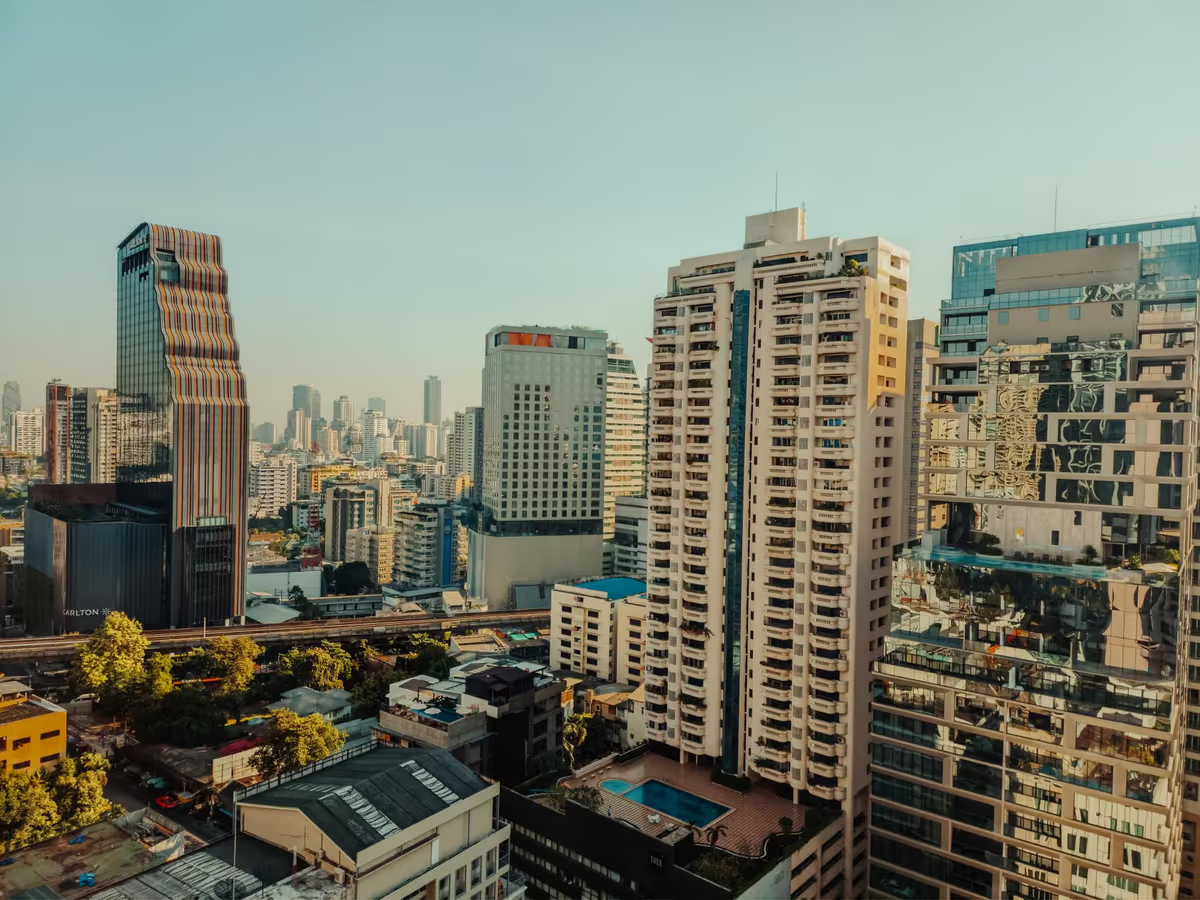
Photo by Nguyễn Trường An Official on Pexels
Thai Developers Pivot to Europe: 4 Takeaways for Phuket Buyers in 2026
This material was prepared with the help of artificial intelligence and checked by a person. Editorial responsibility: Aster Of Asia Co., Ltd..
Responsible for content: Leonid Ustinov, Aster Of Asia Co., Ltd.
Aster of Asia editorial team
One of Thailand's largest developers is buying a luxury hotel in Italy. Meanwhile, tens of thousands of unsold apartments sit in Bangkok, and banks reject up to half of mortgage applications in the segment below 3M THB. These facts are directly connected.
Sansiri is a publicly listed company that has been building in Thailand for more than thirty years. When a player of that scale moves part of its capital into European and American property, it is not chasing exotic bets. It is telling shareholders that a baht invested at home earns less than one invested abroad. According to Nikkei Asia, Sansiri's purchase of a luxury hotel on Lake Como, Italy, is part of a broader pivot by Thai developers away from a sluggish domestic housing market.
For a Phuket buyer the implications are less obvious. The slump hit mass-market Thai housing bought by local buyers with mortgages, not a 25M THB villa in Layan bought with cash. But it reaches Phuket indirectly, through the way developers split money between projects.
We will shortlist properties for your budget
Pick a range and we will send a shortlist with prices, layouts and payment plans within 24 hours.
Quick Answer
- Developers moving capital to Europe and the US reflects weakness in the domestic mass-market housing segment, not in the resort segment for foreigners. The buyers are different, and so is the money.
- The main risk for Phuket is not falling prices but stalled construction. A developer spreading capital across foreign assets while running three off-plan projects in parallel tends to finish each one more slowly.
- Foreign ownership in a condominium is capped at 49% of the building's total area. Within that quota you can hold freehold; land for villas is typically structured as a 30-year lease with contractual renewal.
- Realistic net rental yield in Phuket in 2026 is 4-6% per year after management fees, taxes and vacancy. Brochure promises of 8-10% are calculated before all deductions.
- Thai household debt sits at roughly 87-89% of GDP (Bank of Thailand estimates, 2025). That is why domestic demand is not recovering.
Key Facts
- Sansiri bought a luxury hotel on Lake Como, Italy, as part of a strategy to move part of its assets abroad (Nikkei Asia).
- Thai developers have been steadily expanding in Europe and the US over the past two years, from hotel assets to branded residential projects.
- Mortgage rejection rates in the budget segment (condos and townhouses under 3M THB) reportedly reach 40-50%.
- Phuket's property market has reached 705.055 billion baht, the highest value among Thailand's regional provinces, with 90,597 residential units on the market (Nation Thailand).
- Resort condominiums and villas make up 52% of Phuket supply and about 80% of market value, with condominiums at roughly 339.2 billion baht and villas at roughly 221.7 billion baht (Nation Thailand).
- Sansiri is also targeting 40 billion baht of new Phuket projects over four years, matching its total Phuket development value of the past 15 years, with a first pool villa project planned for H2 2026 (Bangkok Post).
- Foreign buyers are becoming more price-conscious, and developers are increasingly targeting villas priced around 10-20M THB (Bangkok Post).
Why Capital Is Leaving the Country
Mass-market Thai development has hit a ceiling in what buyers can pay. A family earning 40-60 thousand THB a month, already carrying car and credit card loans, fails bank scoring. A developer can cut the price by 15%, offer installments, even cover the transfer fee, and still watch the bank decline the final approval. Marketing cannot fix that.
So the logic is straightforward: putting 50-100 million euros into a finished hotel in Europe, with predictable cash flow and hard-currency revenue, beats launching another condominium in Nonthaburi. It is also a natural hedge against the baht, which strengthened noticeably in 2024-2025 and squeezed export and tourism revenue.
There is a brand effect as well. A presence in Milan or New York gives a Thai developer the international-player status it later uses to sell homes in Phuket.
Phuket and Bangkok Run on Different Economies
This is exactly what headlines about a Thai market collapse get wrong. In Bangkok, prices are set by Thai buyers with mortgages. In Phuket, they are set by foreigners with cash, who care about flights to the island, the rental season and resale prospects over 3-5 years.
That makes national statistics nearly useless when deciding whether to buy a villa in Rawai. More useful numbers are high-season hotel occupancy, the number of direct flights, and the volume of new supply within 3 km of a specific project.
There is one channel through which domestic weakness does reach the island. A developer struggling in Bangkok funds its Phuket construction from a shared pool. If sales in the capital stall and part of the capital goes into an overseas purchase, your building's schedule slips, and not because of the rain.
Where Promised Yields Fall Apart
The most persistent mistake of recent years is believing in guaranteed returns. A scheme of 7% a year for 5 years sounds convincing until you ask where the money comes from. Most often it is already built into the unit price, meaning you are being paid back your own deposit in installments.
The second problem is volume. When thousands of units with identical positioning (a condo-hotel 10 minutes from the beach) hit Bang Tao at the same time, management companies start competing on nightly rates. Occupancy holds, but the rate falls. The owner nets 4-5%, not 8%.
The third is costs missing from the pitch: the annual sinking fund, a common area fee of 50-80 THB per sq m per month, furniture replacement every 4-5 years, a management commission of 30-40% of revenue, and land and building tax.
There is also a counterexample to the general optimism. Some villas bought in 2021-2022, at the peak of enthusiasm, in remote locations such as Thalang, with no view and no beach nearby, are taking over a year to sell in 2026 and at a discount to the purchase price. A rising market does not rescue a poor location.
What I Would Do in 2026
My position: right now, completed or nearly completed property beats off-plan, even after a 15-20% early-entry discount. The reason is the very signal this article started with. When developers move capital abroad, the chance of delays on Thai projects rises, and a foreign buyer in Thailand has few ways to protect themselves.
A practical filter before any deal:
- Find out how many units the developer has actually delivered in Phuket, not nationwide. Visit and look at its five-year-old project.
- Request a payment structure tied to construction milestones, not to the calendar. Payment against completed work is the only real insurance.
- Check the volume of competing supply within 2-3 km scheduled for delivery in the same years.
- Calculate yield on net revenue over a full year, including the low season from May to October.
If your budget is under 5M THB, the investment logic stops working. Fees, taxes and vacancy eat the difference, and the purchase only makes sense as your own home. In that case, none of the above concerns you.
And a simple but effective rule: do not buy remotely. A flight and a week on the island cost far less than a mistake worth several million baht, and a viewing trip in the low season is noticeably cheaper than one in January. You will also see how the location looks in the rain.
FAQ
Does the exodus of developers to Europe mean Phuket prices will fall?
There is no direct link. Phuket's foreign-buyer segment runs on cash and depends on tourist flow and exchange rates, not on Thai mortgages. But in some oversupplied locations, especially on the west coast, pressure on resale prices is already visible.
Which developer is safer, a large listed one or a local Phuket one?
Being listed gives you reporting you can actually read. A local developer with three delivered projects on the island can be more reliable than a Bangkok giant for which Phuket is a side business. Look at delivery history in this specific province.
Can I buy a villa in Phuket as freehold?
Foreigners cannot own land. There are three working options: a 30-year land lease with a written renewal clause, a Thai company with legitimate operating activity, or freehold on a condominium unit within the 49% foreign quota of the building's area.
What is the real net rental yield in Phuket?
4-6% per year for a quality property in a strong location after all costs and accounting for the low season. The 8-10% figures in presentations are usually calculated before the manager's commission and without vacancy.
How risky is buying off-plan right now?
The risk is higher than two years ago. Protect yourself with a payment schedule tied to construction stages, a bank guarantee where one is offered, and verification of the building permit and EIA before the first transfer.
Why did Thais stop buying homes?
Household debt is about 87-89% of GDP by Bank of Thailand estimates for 2025. Banks tightened scoring, and a large share of applications in the budget segment are rejected. Rate cuts do not solve this problem.
Should I wait until 2027 for deeper discounts?
For oversupplied condo projects, possibly. For completed sea-view villas in the limited supply of Kamala, Surin and Layan, waiting more often means a higher entry price, because there is physically little land for such projects.
How can I check that a developer will not freeze construction?
Study the filings of a listed company and its share of completed projects, tour current construction sites and count cranes and workers, and talk to owners in the developer's already delivered buildings. The brochure will not tell you.
The key action before any deal in 2026: ask the developer for a payment schedule tied to actual construction milestones, and walk away if you are offered a calendar-based installment plan with no link to the build. One clause in the contract separates an investment from a donation.
Source: Nikkei Asia
Ready to invest in Thailand? Our experts will help you find the perfect property.
Which area of Thailand suits you best?
We will match properties in locations that fit your goals.
What is your goal?